
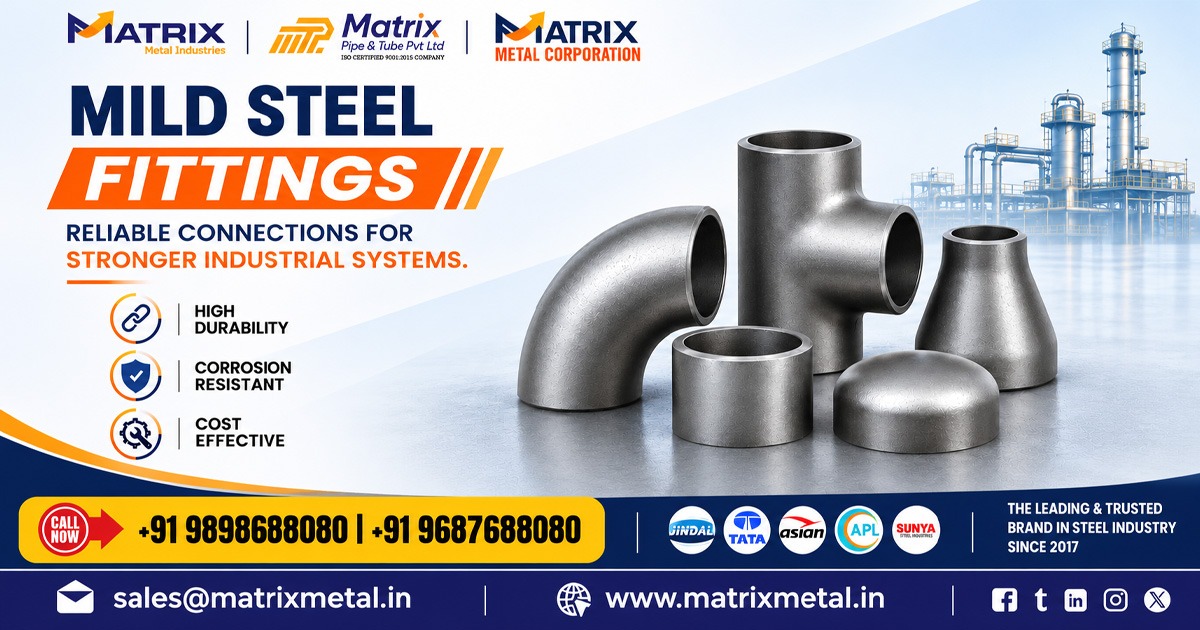
Industrial projects often involve two different requirements: connecting pipeline sections and assembling steel structures. MS Pipe Fittings for Structural and Industrial Pipeline Projects help address these requirements through suitable fitting configurations. Matrix Metal Industries provides manufacturing support from Ahmedabad, Gujarat, India, for industrial metal sourcing requirements.
Understanding the Difference Between Structural and Pipeline Fittings
Mild steel (MS) pipe fittings are used to connect pipe sections, change pipeline direction, create branches, and support different fabrication arrangements. However, structural fabrication and industrial piping have different engineering requirements.
Understanding this difference helps buyers identify the correct fitting before starting procurement.
Structural project requirements:
- Connecting tubular members in fabricated frameworks.
- Creating joints for support structures and equipment frames.
- Developing pipe-based railings and industrial assemblies.
- Supporting fabrication layouts where specific joint configurations are required.
Industrial pipeline requirements:
- Changing the direction of fluid or utility flow.
- Connecting pipeline branches.
- Reducing or adapting pipe sizes.
- Joining pipeline sections according to the approved piping design.
Common fitting configurations include elbows, tees, reducers, couplings, unions, crosses and other connection components. The actual selection depends on the project drawing and intended service.
How to Match Fitting Geometry With the Project Drawing
The fitting shape directly affects how different pipeline or structural members connect. Selecting a component based only on its nominal size may create difficulties during fabrication and installation.
Buyers should understand the purpose of each configuration before finalising their material list.
- MS Elbows: Used to change the direction of a pipeline or tubular arrangement.
- MS Tees: Provide a branch connection where the piping layout requires a three-way arrangement.
- MS Reducers: Connect pipe sections with different nominal sizes.
- MS Couplings: Join compatible pipe sections.
- MS Cross Fittings: Provide four-way connections in suitable piping arrangements.
- MS Caps and Plugs: Close designated pipe ends.
For structural work, the joint configuration must also be checked against the structural drawing. A standard piping fitting should not automatically be treated as a load-bearing structural connector.
Material and Operating Conditions That Influence Selection
The material requirement should be established according to the environment in which the fitting will operate.
For example, a fitting used in a general industrial utility line may have different requirements from one installed in a process pipeline exposed to higher temperatures, pressure, or corrosive substances.
Consider these factors before purchasing:
1. Material Grade
Confirm the specified mild steel grade against the engineering documents. Material identification is particularly important when multiple steel grades are being used in one project.
2. Wall Thickness
The fitting dimensions and wall thickness should be compatible with the connected pipe and the intended design conditions.
3. Operating Environment
Review the fluid, temperature, pressure, moisture exposure and surrounding conditions. Mild steel may require suitable protective coating or another material selection where corrosion is a concern.
4. Connection Type
Determine whether the project requires butt-weld, threaded or another specified connection arrangement.
5. Dimensional Compatibility
Check nominal pipe size, connection dimensions, end preparation and fitting geometry to avoid unnecessary modification at the installation site.
Fabrication and Assembly Considerations at the Project Site
Even correctly selected fittings can create installation difficulties if fabrication planning is incomplete.
For structural assemblies, inaccurate positioning may affect member alignment. In industrial pipelines, incompatible end preparation or incorrect fitting orientation may complicate joint fabrication.
A practical project sequence includes:
1. Drawing Review: Study the approved structural or piping drawings and prepare the fitting schedule.
2. Material Identification: Separate fittings according to grade, size, type and project requirement.
3. Pre-Fabrication Inspection: Check dimensions, visible surface condition and connection details before fabrication.
4. Positioning and Alignment: Place fittings according to the approved layout and verify the alignment of connected members.
5. Joint Preparation: Follow the specified welding or joining procedure using appropriately qualified personnel.
6. Final Inspection: Check completed joints and conduct applicable testing before putting the assembly or pipeline into service.
For pressure-containing systems, inspection and pressure testing must follow the approved engineering procedure and applicable project requirements.
Inspection Points Before Accepting an MS Fitting Consignment
Material inspection is an important part of industrial procurement. A dimensional mismatch or incorrect fitting configuration can affect several connected activities, particularly when a project involves multiple pipeline sizes.
Before accepting MS Pipe Fittings for Structural and Industrial Pipeline Projects, buyers can use the following inspection checklist:
| Inspection area | What to verify |
| Material | Confirm grade and identification |
| Dimensions | Compare with approved drawings |
| Wall thickness | Check specified thickness |
| Fitting geometry | Verify elbow, tee, reducer or other type |
| End preparation | Inspect connection compatibility |
| Surface condition | Look for visible damage or defects |
| Documentation | Check required material and inspection records |
| Quantity | Match the supplied items with the purchase order |
For critical industrial applications, buyers should define acceptance criteria before placing the order. Any material that does not match the approved specification should be referred to the responsible engineering or quality team.
Services
Matrix Metal Industries supports industrial metal product and fabrication-related requirements through the following service areas:
1. MS and SS Pipe Fitting Supply: Assistance with sourcing different fitting configurations for industrial piping and fabrication requirements.
2. Industrial Metal Product Supply: Sourcing support for steel pipes, tubes, plates, sheets, coils and related metal products.
3. MS/SS Fabrication Project Support: Assistance with small, medium and large fabrication project requirements.
4. Product Requirement Coordination: Support in discussing material specifications, dimensions and project-specific sourcing needs.
Location
Matrix Metal Industries provides manufacturing support from Ahmedabad, Gujarat, India. Industrial buyers can explore sourcing requirements across major manufacturing and commercial centres, including Ahmedabad, Sanand, Changodar, Bavla, Vatva, Naroda, Odhav, Kathwada, Rakhial, Kalol, Kadi, Chhatral, Santej, Gandhinagar, Mehsana, Anand, Nadiad, Vadodara, Bharuch, Ankleshwar, Surat, Vapi, Rajkot, Morbi and Jamnagar.
Coordinating Your Fitting Requirement With Matrix Metal Industries
Planning a structural or industrial pipeline project requires clear communication between the engineering, procurement and fabrication teams.
Matrix Metal Industries deals in stainless steel products, MS and SS fittings, and fabrication turnkey projects. The company also lists different industrial fitting configurations, including elbows, tees, couplings, unions and related components.
Through matrixmetal.in, buyers can discuss their material requirements and product enquiries.
With manufacturing support from Ahmedabad, Gujarat, India, Matrix Metal Industries provides a regional contact point for discussing fitting requirements, product selection and industrial fabrication needs.
For a more accurate requirement assessment, buyers should share:
- Required fitting type and quantity.
- Pipe size and material grade.
- Wall thickness and connection details.
- Technical drawings, if available.
- Intended application and operating conditions.
- Project location and delivery requirements.
Sharing these details before ordering helps clarify product suitability and procurement expectations.
Frequently Asked Questions
Q1: Which MS pipe fittings are commonly required for industrial pipeline projects?
A: Elbows, tees, reducers, couplings, unions, crosses, caps and plugs are commonly considered. The required configuration depends on the pipeline layout and connection requirements.
Q2: Can the same MS fitting be used for structural and pipeline applications?
A: Not necessarily. Structural connections and pressure-containing pipeline connections have different design requirements. Always verify the component’s intended use against the approved engineering drawings.
Q3: What information should be shared when requesting an MS fitting quotation?
A: Provide fitting type, nominal size, material grade, wall thickness, connection type, quantity and applicable technical specifications. Drawings are useful for project-specific requirements.
Q4: How should MS fittings be protected against corrosion?
A: Protection depends on the operating environment. Suitable painting, coating or other specified protective treatments may be required to reduce exposure-related corrosion.
Conclusion
Successful structural fabrication and pipeline assembly depend on more than fitting availability. Buyers must coordinate material grade, dimensions, joint configuration and operating conditions with project drawings. For industrial requirements in Ahmedabad and across Gujarat, Matrix Metal Industries offers a contact point for discussing product selection and procurement planning.
Discuss your upcoming pipeline or structural fabrication requirement with Matrix Metal Industries to identify suitable MS fitting options.
CALL US:
Sales & Service
+91 9687688080
Mr. Narayan Choudhary
+91 9898688080
E-MAIL US:
sales@matrixmetal.in
matrixmetalind88@gmail.com
sales@matrixpipeandtube.com
Contact us today for inquiries or to place an order!
