
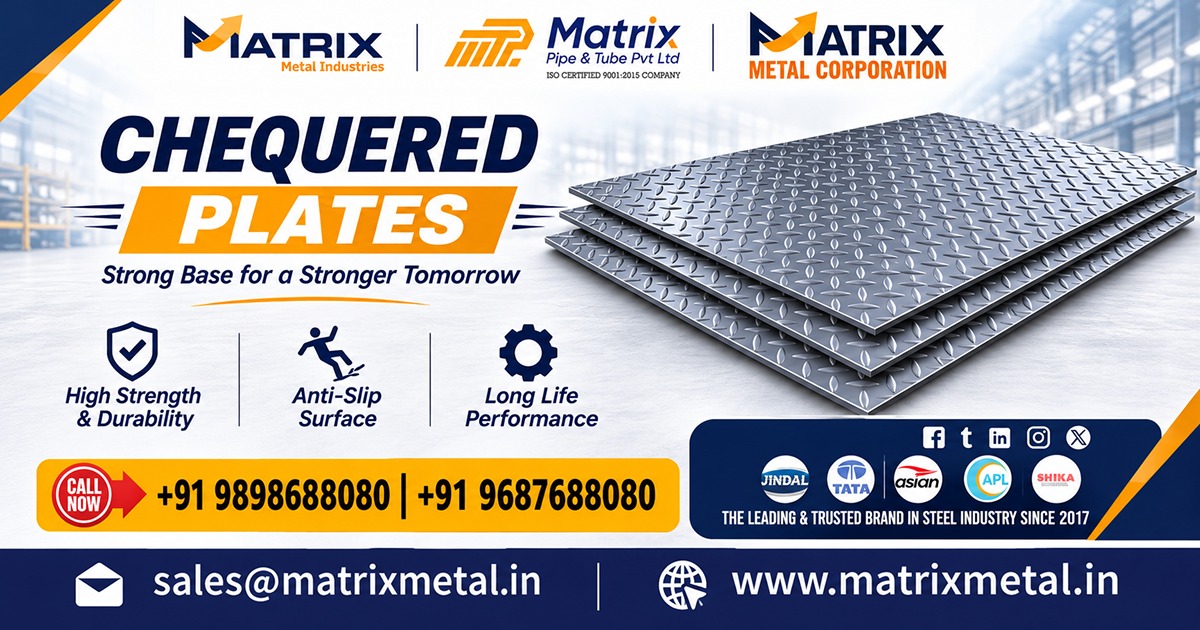
Industrial flooring, access platforms, and vehicle surfaces require metal sheets that can handle regular movement and operating loads. Finding a reliable Chequered Sheets and Plates Supplier In India helps buyers select suitable thickness, material, dimensions, and surface patterns. Matrix Metal Industries provides manufacturing support from Ahmedabad, Gujarat, India.
Understanding the Role of Chequered Sheets in Industrial Flooring
Chequered sheets and plates are metal products manufactured with a raised pattern on one surface. This patterned finish provides additional grip compared with a plain, smooth metal sheet, making it suitable for areas where people, equipment, or materials move regularly.
These products are commonly considered for:
- Industrial walkways and factory flooring.
- Staircases, steps, and access platforms.
- Commercial vehicle floors and loading areas.
- Warehouse passages and maintenance platforms.
- Industrial equipment covers and working surfaces.
- Construction and fabrication projects.
The raised pattern helps reduce slipping risks under suitable operating conditions. However, actual floor safety also depends on installation quality, surface cleanliness, footwear, drainage, and workplace conditions.
Choosing the Right Thickness, Material and Plate Pattern
Selecting a metal plate involves more than comparing prices. Buyers should match the product specifications with the expected load, installation environment, and intended application.
Consider the following factors before ordering:
| Selection Factor | What Buyers Should Check |
| Base Material | Carbon steel, stainless steel, or aluminium, depending on application and availability |
| Thickness | Select according to load requirements and structural support |
| Sheet Dimensions | Confirm required length, width, and cutting requirements |
| Pattern Design | Check the raised pattern and its suitability for the intended surface |
| Load Conditions | Consider pedestrian movement, machinery, vehicles, and material handling |
| Environment | Evaluate moisture, chemicals, outdoor exposure, and corrosion risks |
| Surface Finish | Check whether the finish is suitable for the installation environment |
| Budget | Compare material grade, thickness, dimensions, and total supply cost |
Practical buying advice:
- Do not select a plate based on thickness alone. Its support structure and load distribution also matter.
- For outdoor or moisture-prone environments, evaluate corrosion protection requirements.
- For chemical processing areas, check material compatibility with the chemicals involved.
- Confirm whether the project requires full sheets, cut-to-size plates, or specific dimensions.
From Material Requirement to Final Installation: How the Process Works
Understanding the procurement and installation sequence helps avoid specification errors and unnecessary material wastage.
Step 1: Identify the Application
Determine whether the plate will be used for flooring, stair treads, vehicle platforms, walkways, or fabrication work.
Step 2: Finalize Product Specifications
Confirm the material grade, thickness, sheet dimensions, pattern, quantity, and expected operating conditions.
Step 3: Check the Supplied Material
Inspect the plates for dimensional accuracy, visible surface damage, pattern consistency, and material identification against the agreed order.
Step 4: Prepare and Install the Plates
Arrange suitable structural supports, cutting, positioning, welding, or mechanical fastening according to the project design.
After installation, inspect the joints, edges, surface alignment, and supporting structure before putting the area into regular use.
Quality Checks That Matter Before Purchasing Metal Plates
A suitable supplier should understand the application rather than simply provide a price per sheet or kilogram.
Before confirming an order, buyers should evaluate:
- Material Identification: Verify the supplied material against the agreed grade and purchase specifications.
- Thickness Measurement: Check the actual plate thickness at appropriate locations.
- Dimensional Accuracy: Confirm length, width, and thickness against the purchase order.
- Pattern Condition: Examine the raised surface for visible defects, irregularities, or damage.
- Surface Inspection: Look for excessive rust, dents, cracks, and handling damage.
- Quantity Verification: Match the supplied quantity with the approved order.
- Documentation: Request applicable material test reports and product documentation where required.
- Delivery Condition: Check packaging and transportation arrangements to prevent surface damage.
For large industrial orders, buyers should also clarify material traceability, inspection requirements, delivery schedules, and acceptable product variations before dispatch.
Installation and Maintenance: Keeping Chequered Surfaces Serviceable
Correct installation and regular inspection help maintain the condition of industrial metal flooring.
Installation considerations:
- Prepare a properly designed supporting structure.
- Confirm the plate orientation and positioning before fixing.
- Use suitable welding or fastening methods according to the material and application.
- Avoid leaving sharp edges or improperly finished joints.
- Consider drainage requirements in areas exposed to water or cleaning operations.
- Ensure the completed surface does not create unexpected height differences or trip hazards.
Maintenance practices:
- Remove accumulated dust, oil, grease, and production residues.
- Inspect raised patterns for excessive wear or damage.
- Check welded joints, fasteners, and supporting structures periodically.
- Address corrosion according to the selected material and site conditions.
- Replace damaged sections when their condition affects safe operation.
Regular cleaning is particularly important because oil, grease, and accumulated dirt can reduce the grip provided by the raised pattern.
Services
- Product Requirement Consultation: Assistance in understanding material, thickness, dimensions, and application requirements.
- Chequered Plate Selection Guidance: Support in identifying suitable plate specifications for flooring and fabrication projects.
- Order and Supply Coordination: Coordination of product requirements, quantities, and delivery planning.
- Technical Requirement Assistance: Guidance regarding product suitability, inspection considerations, and project-related requirements.
Industrial Demand for Chequered Plates Across India
Manufacturing facilities, warehouses, infrastructure projects, transport operations, and fabrication industries require dependable metal flooring and access solutions. Chequered plates are relevant to projects across different industrial regions of India. Major markets and industrial locations include Ahmedabad, Surat, Vadodara, Rajkot, Gandhinagar, Bharuch, Ankleshwar, Vapi, Mumbai, Pune, Nashik, Nagpur, Thane, Aurangabad, Delhi, Faridabad, Gurugram, Ludhiana, Jalandhar, Jaipur, Jodhpur, Indore, Bhopal, Bengaluru, Chennai.
Why Choose Matrix Metal Industries for Chequered Plate Requirements?
Selecting the right metal supplier involves understanding the application, verifying specifications, and coordinating the material requirement with the project schedule.
Matrix Metal Industries supports buyers looking for suitable metal products by focusing on:
- Understanding project-specific material and dimensional requirements.
- Helping buyers evaluate product suitability before ordering.
- Coordinating manufacturing support from Ahmedabad, Gujarat, India.
- Discussing supply requirements for industrial and commercial applications.
For product details and company information, visit the official website: https://matrixmetal.in/
Buyers can discuss their required material, thickness, dimensions, quantity, and application to establish suitable product specifications before placing an order.
Frequently Asked Questions
Q1: What are chequered sheets and plates used for?
A: They are commonly used for industrial flooring, staircases, walkways, vehicle platforms, loading areas, and maintenance access surfaces where a raised pattern can provide additional grip.
Q2: How do I determine the correct thickness for a chequered plate?
A: Consider the expected load, support spacing, plate dimensions, installation method, and operating conditions. For structural applications, confirm the thickness through the project design or engineering requirements.
Q3: Are chequered plates suitable for outdoor installations?
A: They can be used outdoors when the material and surface protection are appropriate for the environment. Consider exposure to rain, moisture, chemicals, and corrosion before selecting the product.
Q4: What information should I provide when requesting a quotation?
A: Share the material grade, required thickness, sheet dimensions, quantity, surface pattern preference, application, and delivery location. This helps the supplier understand the requirement and prepare a relevant quotation.
Conclusion
Choosing suitable chequered plates requires attention to material quality, thickness, dimensions, load conditions, and installation requirements. Businesses across India can evaluate these factors before purchasing. Matrix Metal Industries, with manufacturing support from Ahmedabad, Gujarat, India, can assist buyers in discussing their industrial metal requirements.
Looking for suitable metal plates for your industrial or commercial project? Contact Matrix Metal Industries through https://matrixmetal.in/ to discuss your material specifications, quantity, and supply requirements.
CALL US:
Sales & Service
+91 9687688080
Mr. Narayan Choudhary
+91 9898688080
E-MAIL US:
sales@matrixmetal.in
matrixmetalind88@gmail.com
sales@matrixpipeandtube.com
Contact us today for inquiries or to place an order!
View Product: Click Here
